Ruth in the Bible: Life, Lineage, and Legacy
The narrative of Ruth in the Bible offers a distinct perspective on the social and spiritual life of ancient Israel during the period of the judges. By focusing on the lives of two women navigating displacement, loss, and economic hardship, the text moves beyond simple moral tropes to examine the mechanics of family survival and legal custom. Understanding the historical context of this account provides a clearer view of how one woman from Moab became a central figure in the ancestral line of both King David and, eventually, Jesus.
Who Was Ruth in the Bible?
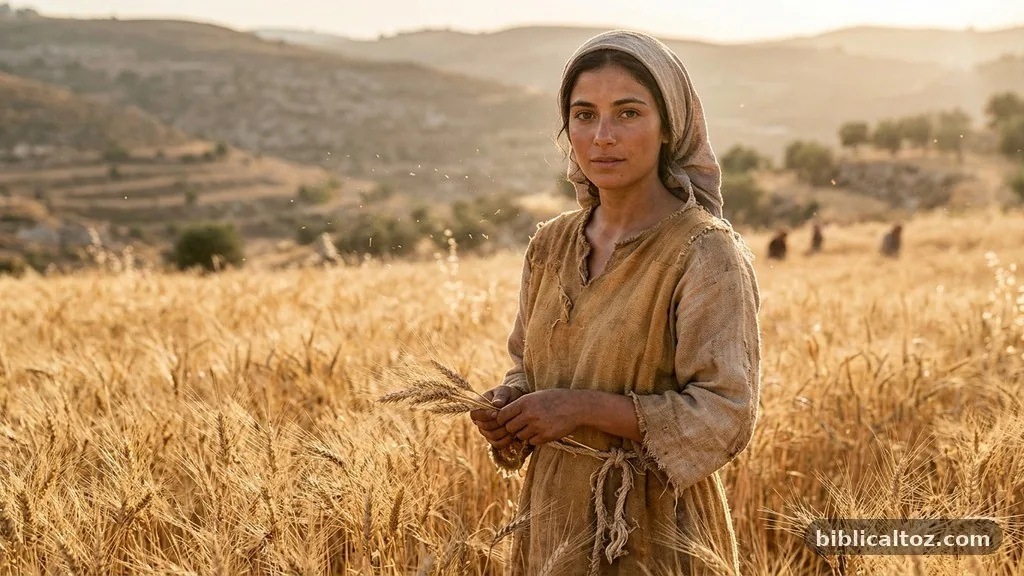
Ruth is introduced as a woman of Moab who married into an Israelite family residing in her homeland. Following the death of her husband, her father-in-law, and her brother-in-law, she made the decision to leave her native culture to accompany her mother-in-law, Naomi, back to Bethlehem.
Her identity is defined primarily by her foreign origin and her subsequent integration into the covenant community of Israel. She is not a prophet or a queen, but a private individual whose personal choices had far-reaching consequences for the political and religious history of the Hebrew people.
Ruth’s Background as a Moabite Woman
The Moabites were a neighboring people with a complex history involving the Israelites, often characterized by rivalry and territorial disputes. As a Moabite woman, Ruth belonged to a group traditionally excluded from full participation in the assembly of the Lord under certain interpretations of the Law of Moses.
Her presence in Bethlehem represents a significant intersection of cultural boundaries. Despite these social barriers, the narrative highlights her initiative and her refusal to abandon her mother-in-law, marking her as a character who acts with a level of commitment that defies the expected norms of her time.
Ruth and Naomi: Their Relationship and Journey to Bethlehem
The relationship between Ruth and Naomi is the structural foundation of the book. Following the deaths of Elimelech, Mahlon, and Chilion, the two women were left in a vulnerable economic state with no male protection.
Naomi decided to return to Bethlehem, expecting her daughter-in-law Orpah to remain in Moab. Ruth’s insistence on joining Naomi is documented as a pivotal shift in her life, where she explicitly committed to adopting Naomi’s people and God as her own.
- Ruth left her ancestral home in Moab.
- She traveled to Bethlehem during the barley harvest.
- She accepted the risks of being a foreign widow in a new land.
- She supported Naomi through labor, specifically by gleaning in the fields.
Ruth Meets Boaz: An Accurate Summary of the Events
Upon arriving in Bethlehem, Ruth began working in the fields to provide food for herself and Naomi. By chance, she ended up gleaning in the field belonging to Boaz, a wealthy landowner and a relative of the deceased Elimelech. When Boaz noticed Ruth, he instructed his workers to leave extra grain for her, acknowledging her reputation for loyalty to Naomi.
Later, at Naomi’s suggestion, Ruth approached Boaz at the threshing floor, signaling her willingness to seek the protection of a kinsman-redeemer. Boaz acknowledged his legal obligation and took the necessary steps to secure the right to redeem the land and marry Ruth, ensuring the continuation of the family line.
Who Was Boaz, and What Was His Relationship to Ruth?
Boaz was a prominent man in Bethlehem and a kinsman to the late Elimelech. In the context of the Hebrew law, he served as a potential redeemer. This role involved protecting the interests of a deceased relative’s family, which included buying back ancestral land and, in some traditions, ensuring the family name continued through marriage.
The relationship between Ruth and Boaz was not merely personal; it was a legal and social arrangement that fulfilled specific tribal obligations. Boaz acted as the guardian of Ruth’s needs, and through their marriage, he restored the family estate that had been lost after Elimelech’s death.
| Character | Role in the Narrative |
|---|---|
| Naomi | The matriarch who returns to her roots in Bethlehem. |
| Ruth | The Moabite woman who secures the future of the family. |
| Boaz | The kinsman-redeemer who facilitates the legal restoration. |
| Obed | The son of Ruth and Boaz, grandfather of King David. |
The Themes of Loyalty, Kindness, and Providence in the Book of Ruth
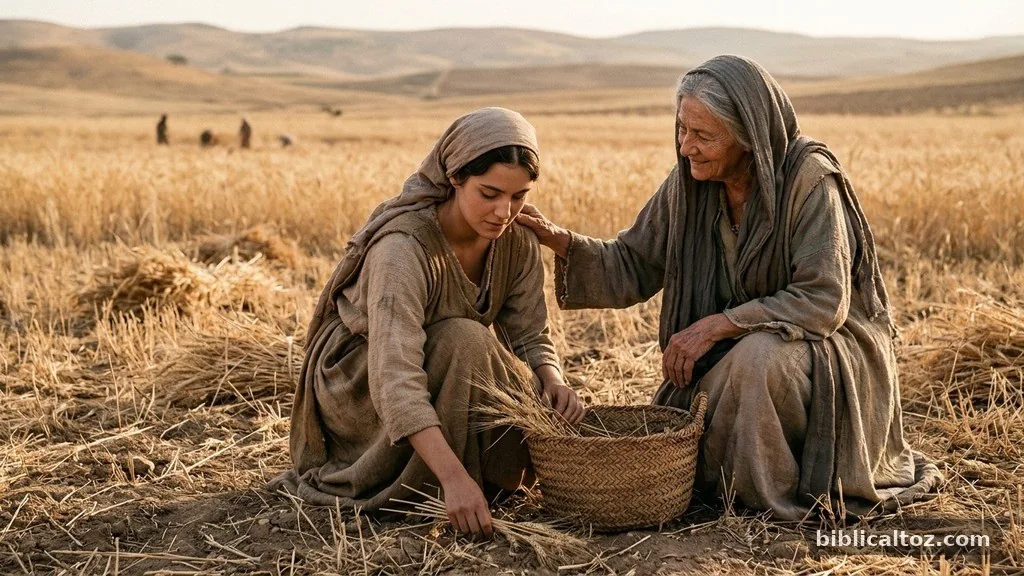
The text explores the concept of hesed, a Hebrew term often translated as loving-kindness or steadfast loyalty. This loyalty is displayed through Ruth’s actions toward Naomi and through Boaz’s adherence to the law.
The narrative also touches on the idea of providence, not through miraculous interventions, but through the everyday actions of people making choices within the bounds of their society. The harvest serves as the backdrop for these events, grounding the theological significance in the tangible reality of agricultural survival.
Ruth in the Genealogy of King David
The conclusion of the book identifies Ruth as the great-grandmother of King David. By bearing a son named Obed, Ruth became an ancestor to the most significant monarch in Israelite history.
This inclusion is remarkable because it highlights that the royal line of David was not purely Israelite by blood. It demonstrates that the formation of the monarchy was deeply intertwined with the experiences of foreigners who had fully committed themselves to the welfare of the house of Israel.
How Is Ruth Connected to Jesus?
The New Testament makes the connection between Ruth and Jesus explicit in the opening chapter of the Gospel of Matthew. In the genealogy of Jesus, Ruth is one of the few women mentioned by name, specifically noted as the mother of Obed by Boaz.
This genealogical link serves to emphasize that the ancestry of Jesus includes those who were once outsiders. By tracing the lineage back through David and Boaz to Ruth, the Gospel writer highlights the inclusive nature of the messianic line, showing that the history of Israel’s savior is rooted in the faithfulness of a Moabite woman.
Why Is Ruth’s Story Important in the Bible?
The story of Ruth in the Bible matters because it provides a bridge between the era of the judges and the rise of the monarchy. It illustrates how the legal frameworks of the time, such as the role of the kinsman-redeemer, were utilized to protect the vulnerable. Furthermore, it challenges the exclusivity of the Israelite community, showing that loyalty and character were valued traits that transcended ethnic origins.
FAQs
Was Ruth the only foreigner in the genealogy of Jesus?
No, the genealogy of Jesus in Matthew includes other women, some of whom were also foreigners or had complex backgrounds, such as Rahab the Canaanite.
What does the term kinsman-redeemer mean?
A kinsman-redeemer was a male relative who had the legal responsibility to protect the interests of his kin, including buying back land or marrying a widow to ensure the family name survived.
Why did Ruth go to Bethlehem?
Ruth traveled to Bethlehem because her mother-in-law, Naomi, decided to return there after hearing that the famine in the land had ended and the Lord had provided food for His people.
What is the significance of the barley harvest in the story?
The harvest provided the context for Ruth to meet Boaz, as it was the season during which the poor were permitted to glean left-over grain from the fields to survive.
Did Boaz marry Ruth immediately?
Boaz had to follow legal procedures first, which included offering another closer relative the first right of redemption for the land before he could marry Ruth.
How is Ruth related to King David?
Ruth is the great-grandmother of King David; her son Obed was the father of Jesse, who was the father of David.
Conclusion
The account of Ruth in the Bible remains a significant historical and theological touchstone. It captures a moment in time where individual agency and adherence to ancient legal customs converged to shape the future of a nation. By tracing the lineage from a Moabite woman to the house of David and eventually to the genealogy of Jesus, the text provides a window into the diverse heritage of the biblical narrative.
Engaging with these records allows for a clearer understanding of how the themes of loyalty and redemption are woven throughout the history of Israel. Whether you are studying the social history of the ancient Near East or the specific ancestry mentioned in the Gospels, the life of Ruth offers a compelling look at the complexities of the biblical record.