Moses in the Bible: Life, Leadership, and Legacy
The narrative of moses in the Bible serves as a foundational pillar for understanding the relationship between the divine and humanity. From his humble beginnings as an infant hidden in the Nile to his role as the primary lawgiver of the Hebrew people, his journey reflects themes of liberation, obedience, and the heavy burden of leadership.
By examining the biblical record, we gain insight into a man who, despite his personal insecurities and flaws, became the instrument through which an entire nation was forged. This exploration of his life offers a look at how one individual’s encounter with the sacred can alter the course of history for generations to come.
Moses’ Birth and Early Life in Egypt

The story begins during a period of intense oppression for the Hebrews living in Egypt. Pharaoh, fearing the growing strength of the israelites, ordered that every newborn Hebrew son be cast into the Nile. To save her child, Moses’ mother placed him in a waterproof basket among the reeds of the river.
He was discovered by Pharaoh’s daughter, who adopted him into the royal household, providing him with an upbringing in the heart of the egyptian court. Despite his royal education, he maintained an underlying connection to his own people, which eventually led him to defend a Hebrew slave by killing an overseer. This act forced him to flee to the land of Midian, where he spent forty years as a shepherd, far removed from the power and privilege of the palace.
Moses and the Burning Bush
While tending his flock near Mount Horeb, Moses encountered a sight that defied natural explanation: a bush that burned with fire yet was not consumed. When he turned aside to investigate, the Lord spoke to him from the midst of the flames. This moment marked a radical shift in his life, as the divine presence commanded him to return to Egypt to act as a deliverer.
Moses initially resisted, citing his lack of eloquence and fear of the authorities. The encounter highlights the tension between his personal reluctance and the unyielding will of the Creator, establishing his identity not as a man of power, but as a humble messenger.
God’s Call to Lead Israel Out of Egypt
The call to lead the people out of bondage was not merely a political mission but a spiritual one. God revealed His name to Moses, identifying Himself as the one who remembers His covenant with Abraham, Isaac, and Jacob. Moses was tasked with confronting the most powerful ruler of the age to demand the release of a massive workforce.
To support his mission, the Lord provided signs and wonders, including the transformation of his staff into a serpent. This phase of his life underscores the necessity of divine empowerment when an individual faces systemic evil that seems impossible to overcome.
Moses and the Ten Plagues
The confrontation between Moses and Pharaoh escalated through a series of ten plagues designed to demonstrate the supremacy of the Hebrew God over the pantheon of Egypt. Each event, from the turning of the Nile to blood to the final tragedy of the death of the firstborn, served as a direct challenge to the authority of the Egyptian state.
| Plague | Significance |
|---|---|
| Water to Blood | Judgment on the Nile, the source of life. |
| Frogs and Gnats | Disruption of the natural and domestic order. |
| Darkness | A direct strike at the sun god, Ra. |
| Death of Firstborn | The final catalyst for the release of the people. |
The Exodus and Crossing of the Red Sea
Following the final plague, Pharaoh relented, allowing the people to depart. However, he soon pursued them with his chariots, trapping the fleeing masses against the waters of the Red Sea. In a moment of supreme crisis, Moses stood before the people and instructed them to remain still and witness the salvation of the Lord.
The waters parted, allowing the people to cross on dry land before returning to consume the pursuing army. This event remains the defining moment of national identity for the Israelites, establishing the theme of redemption through the intervention of the divine.
Moses at Mount Sinai and the Giving of the Law
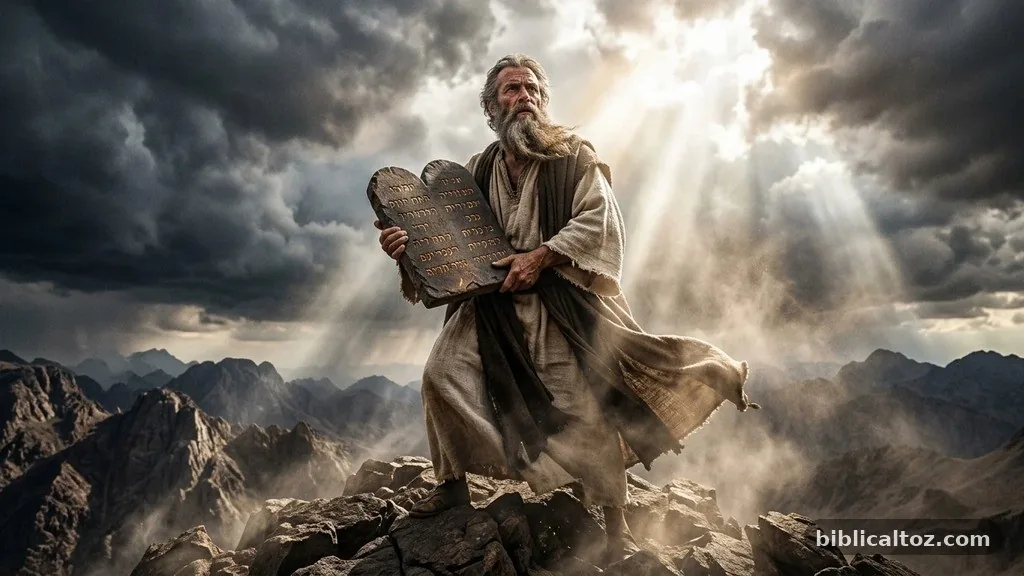
After the crossing, the people journeyed to Mount Sinai, where the relationship between the people and their God was formalized. Moses ascended the mountain to receive the Torah, including the Ten Commandments and instructions for the tabernacle.
This period solidified his role as the mediator between the divine and the community. The law provided a moral and social structure for the nascent nation, emphasizing justice, holiness, and the necessity of maintaining a distinct identity in a foreign land.
Moses as a Leader in the Wilderness
Leadership in the wilderness proved to be a grueling test of patience and endurance. Moses faced constant complaints, rebellions, and the logistical nightmare of sustaining a large population in a desert environment.
His leadership style, as depicted in the biblical accounts, was characterized by his willingness to stand in the gap for his people, even when they turned against him. His primary responsibilities included:
- Resolving judicial disputes among the tribes.
- Maintaining the purity of the camp according to the law.
- Directing the movement of the people based on divine guidance.
- Serving as the primary communicator of the divine will.
Moses’ Strengths, Struggles, and Mistakes
Though revered as a prophet, the text is candid about his human failings. He struggled with anger, as seen when he struck the rock in frustration at Meribah, and he occasionally expressed deep exhaustion with the weight of leadership.
His greatest strength was his humility and his steadfast commitment to the vision he was given, despite the persistent resistance he encountered from both the people and his own family. These imperfections make his story relatable, showing that even a man who spoke with God face-to-face was not immune to the pressures of human existence.
Why Moses Was Not Allowed to Enter the Promised Land
The decision to bar Moses from entering the land of Canaan is one of the most sobering moments in the Pentateuch. When the people lacked water at Meribah, the Lord commanded Moses to speak to the rock to bring forth water. Instead, in a fit of irritation, he struck the rock twice.
This act was interpreted as a failure to uphold the sanctity of the divine in the sight of the people. While he was permitted to view the land from the summit of Mount Pisgah, he was prohibited from crossing the Jordan, marking the conclusion of his earthly service.
Moses’ Death and Legacy
Moses passed away on Mount Nebo, and the text notes that the Lord buried him in an unknown location. His death marked the end of an era, but his legacy as the lawgiver remained the foundation for all subsequent generations of Israel.
He left behind a body of literature that shaped the ethics, culture, and theology of a people for thousands of years. His influence is not measured merely by the territory he navigated, but by the legal and spiritual framework he established for his descendants.
Moses in the New Testament and His Relationship to Jesus
In the New Testament, Moses is frequently cited as a witness to the coming of the Messiah. He appears alongside Elijah during the Transfiguration in Matthew 17, signifying his role as the representative of the Law.
John 1:17 contrasts the law given through him with the grace and truth that came through Jesus. This comparison does not diminish his importance but rather positions him as the one who prepared the way for the ultimate fulfillment of the covenant.
Frequently Asked Questions
What were the primary character traits of Moses?
He is described as a humble man, patient under pressure, and deeply committed to the divine mandate, though he also struggled with anger and self-doubt.
How long did Moses lead the people in the wilderness?
According to the biblical narrative, his leadership lasted forty years, covering the duration of the wandering from the exodus from Egypt until the arrival at the borders of the Promised Land.
Was Moses an Egyptian or a Hebrew?
He was born to Hebrew parents, though he was raised as an Egyptian prince, a dual identity that was central to his eventual ability to negotiate with Pharaoh.
Did Moses actually write the first five books of the Bible?
Traditional religious views attribute the authorship of the Torah to him, while modern academic inquiry often discusses the historical process of oral and written traditions that formed these texts.
What was the nature of his disability?
The text mentions that he was not eloquent and described himself as slow of speech, which led to his brother Aaron acting as his spokesperson during the initial confrontations with Pharaoh.
What is the significance of his encounter with the burning bush?
The event serves as his personal commission, where he transitioned from a shepherd in exile to the appointed leader of the liberation movement.
Conclusion
The life of this iconic figure remains a testament to the idea that an individual, regardless of their personal limitations, can be used to initiate profound change. Through his efforts, a group of enslaved people was transformed into a nation governed by a unique moral code. His journey from the banks of the Nile to the slopes of Mount Nebo illustrates the complexities of answering a call that demands everything one has to offer.
As you reflect on his story, consider the ways in which his persistence and eventual submission to the divine will continue to resonate in modern discussions of leadership and ethics. Engaging with the life of this prophet provides a richer understanding of the foundational narratives that shaped the ancient world.