What Does the Bible Say About Speaking in Tongues?
Understanding what the Bible says about speaking in tongues requires looking closely at the original context of the early church. Many believers find themselves seeking clarity on this spiritual experience, as it appears in various forms throughout the New Testament.
By examining the accounts in Acts alongside the specific instructions found in the letters to the Corinthians, we can gain a clearer perspective on how this gift functioned historically. This exploration provides a foundation for evaluating personal experiences and theological views through the lens of ancient scripture, helping you determine how these practices align with the broader teachings of the Christian faith.
The Biblical Meaning of Tongues
In the New Testament, the term for speaking in tongues is glossolalia, which literally translates to speaking in languages. When the Bible discusses this phenomenon, it generally refers to an utterance that is not learned by the speaker through natural means. The primary purpose of this gift, as described in the early chapters of Acts, was to communicate the message of God in languages that the hearers understood, even if the speaker had never studied those dialects.
However, the usage mentioned by the apostle Paul in his letters to the church at Corinth suggests a different dimension. Here, the gift is sometimes described as a private form of prayer or a spiritual utterance that requires an interpreter for the congregation to benefit. Distinguishing between these two manifestations is essential for anyone trying to understand the full scope of what the Bible says about speaking in tongues.
Key Accounts in the Book of Acts
The book of Acts records three distinct instances where believers received the Holy Spirit and manifested the gift of tongues. Each event serves a specific purpose in the narrative of the early church’s expansion.
Pentecost in Acts 2
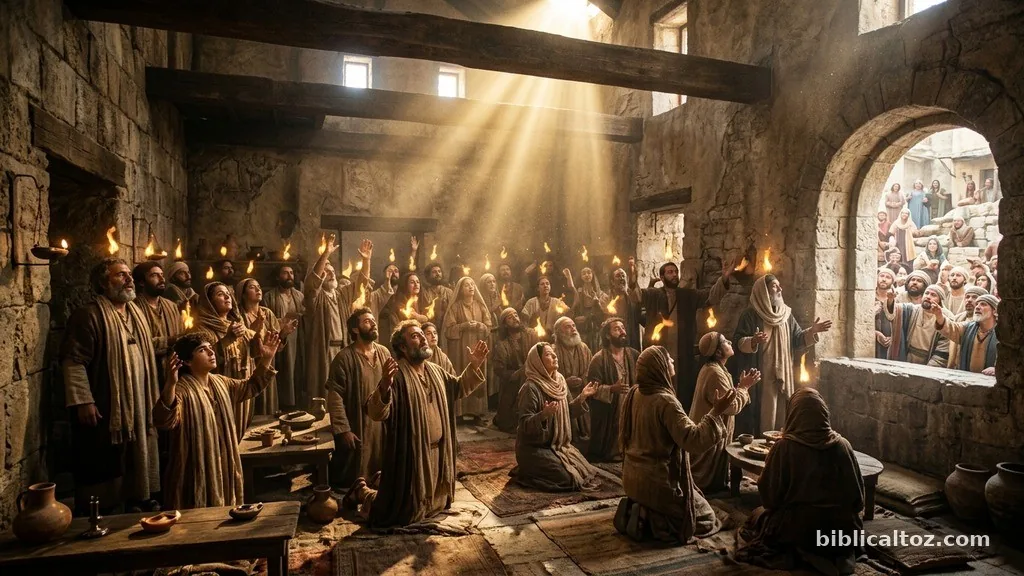
The most famous account occurs in Acts 2:1–13, where the disciples were gathered in Jerusalem. When the Holy Spirit descended, they began to speak in other languages, enabling the gathered crowd to hear the gospel in their own native tongues. This was a miraculous sign that bridged the gap between different cultures, demonstrating that the gospel was for all nations. It functioned as a clear, intelligible witness to the power of God.
The Household of Cornelius
In Acts 10:44–48, the gift appears among the Gentiles. As Peter spoke to the household of Cornelius, the Holy Spirit fell upon them, and they began speaking in tongues and magnifying God. This event served as a sign to the Jewish believers that God had truly accepted the Gentiles into the new covenant. The gift acted as an undeniable confirmation of their inclusion in the church.
Disciples at Ephesus
Acts 19:1–7 records Paul meeting certain disciples in Ephesus who had only received the baptism of John. After Paul instructed them and laid his hands on them, the Holy Spirit came upon them, and they spoke in tongues and prophesied. This moment solidified their connection to the new movement of the church and confirmed their reception of the Holy Spirit.
Pauline Teachings in 1 Corinthians
Paul provides the most detailed instruction regarding the practical application of tongues in 1 Corinthians 12–14. Unlike the public, intelligible witness seen in Acts, Paul addresses tongues as a complex spiritual gift that requires regulation within a gathered assembly.
Gifts and the Body of Christ

In 1 Corinthians 12, Paul emphasizes that the Holy Spirit distributes gifts as He wills for the common good. He uses the analogy of a human body to show that just as a body needs many parts to function, the church needs a variety of spiritual gifts. He explicitly asks in 1 Corinthians 12:29–30 if all are apostles or if all speak in tongues, implying that not every believer is expected to possess the same gift.
The Necessity of Interpretation
Paul places a high value on intelligibility. He argues that if someone speaks in a tongue in a public meeting, it does not build up the church unless someone interprets the words. Without an interpreter, the speaker is only speaking to God, and the congregation remains uninstructed. Therefore, he encourages believers to seek gifts that edify others, such as prophecy, over those that remain mysterious to the listeners.
Order in Worship
The overarching rule for public worship in 1 Corinthians 14 is that everything should be done decently and in order. Paul limits the number of people who should speak in tongues during a service and insists that there must be an interpreter present. If no one can interpret, the person should remain silent in the church and speak to themselves and to God.
| Context | Primary Purpose | Requirement |
|---|---|---|
| Acts 2 (Pentecost) | Witness to diverse nations | Intelligible language |
| 1 Corinthians 14 | Edification of the church | Interpretation required |
| Private Prayer | Personal communion with God | No interpreter needed |
Theological Perspectives
Christians have long debated the ongoing nature of spiritual gifts, leading to two primary schools of thought. Understanding these perspectives helps clarify why different traditions approach the subject in unique ways.
- Cessationism: This view holds that the miraculous gifts of the apostolic age, including tongues, were temporary. Proponents argue these gifts were intended to confirm the authority of the apostles and the early church and are no longer necessary now that the canon of scripture is complete.
- Continuationism: This perspective maintains that all spiritual gifts, including tongues, are available to the church today. Followers believe these gifts are intended to continue until the return of Christ, serving as a vital component of spiritual life and growth.
When evaluating modern claims of speaking in tongues, many theologians suggest using a framework based on biblical consistency. This includes testing whether the practice aligns with the fruit of the Spirit, whether it promotes unity within the church, and whether it adheres to the scriptural requirement for order and edification.
Frequently Asked Questions
Is speaking in tongues a requirement for salvation?
No, the Bible does not present speaking in tongues as a requirement for salvation. The scriptures emphasize that salvation is received through faith in Christ, and the Holy Spirit is given to all believers at the moment of conversion.
Can speaking in tongues be fake?
The New Testament warns about spiritual deception and the need to test the spirits. Paul’s insistence on order and interpretation in 1 Corinthians suggests that any practice which causes confusion or deviates from biblical truth should be carefully scrutinized by church leadership.
What if I don’t speak in tongues?
Paul makes it clear that the Holy Spirit gives different gifts to different people. Not every believer is expected to speak in tongues, and the absence of this gift does not indicate a lack of spiritual maturity or an absence of the Holy Spirit.
Why did the early church need tongues?
In the book of Acts, tongues served as a sign to validate the gospel message to diverse groups and to confirm that the Holy Spirit was being poured out on both Jews and Gentiles. It was a sign of the new era of the kingdom of God.
Conclusion
What the Bible says about speaking in tongues presents a nuanced picture of a gift designed for the benefit of the body of Christ. Whether through the miraculous, multilingual witness recorded in Acts or the orderly, interpreted speech described by Paul, the focus remains on the glory of God and the edification of the church.
By approaching these scriptures with humility and a desire for biblical balance, you can better understand how spiritual gifts function in the life of a believer. We invite you to continue your study of the Word at BiblicalToZ.com, where we delve into the foundational truths of the faith to help you grow in your walk with God.