The Parable of the Good Samaritan: Meaning and Application
The parable of the Good Samaritan stands as one of the most provocative stories Jesus ever told, challenging the social and religious boundaries of his day. Recorded in the book of Luke, this account begins with an expert in the law attempting to test the Lord by asking what he must do to inherit eternal life.
By shifting the focus from abstract legal definitions to radical, sacrificial action, the narrative forces every reader to confront the condition of their own heart. Understanding the context of this story provides a window into the nature of true faith and the expansive definition of who qualifies as our neighbor.
The Context of the Encounter

The story emerges from a dialogue between Jesus and a lawyer who was well-versed in the Torah. This expert in the law sought to justify himself by asking a pointed question: “Who is my neighbor?”
In the cultural climate of first-century Judea, the concept of a neighbor was often narrowly defined. Religious leaders of the time frequently categorized people into groups that were worthy of love and those who were considered enemies or outcasts.
Jesus responded with a story about a man traveling from Jerusalem down to Jericho. The road was notoriously dangerous, winding through desolate, rocky terrain perfect for bandits.
The traveler was attacked, stripped, beaten, and left half-dead on the side of the road. This setup was not merely a narrative device; it was a common reality for travelers in that region, making the listeners immediately identify with the vulnerability of the victim.
The Response of the Religious Elite
As the story unfolds, a priest passes by the injured man. He sees the victim but chooses to cross to the other side of the road. Shortly after, a Levite performs the same action.
Both of these men were religious professionals who occupied high status within the community. Their avoidance was likely motivated by a desire to remain ritually pure; touching a corpse or a person near death could render them unclean according to the law, preventing them from performing their duties.
| Character | Status | Action Taken |
|---|---|---|
| Priest | High Religious Authority | Passed by on the other side |
| Levite | Religious Assistant | Passed by on the other side |
| Samaritan | Social Outcast | Stopped, bandaged, and provided care |
The Shocking Role of the Samaritan
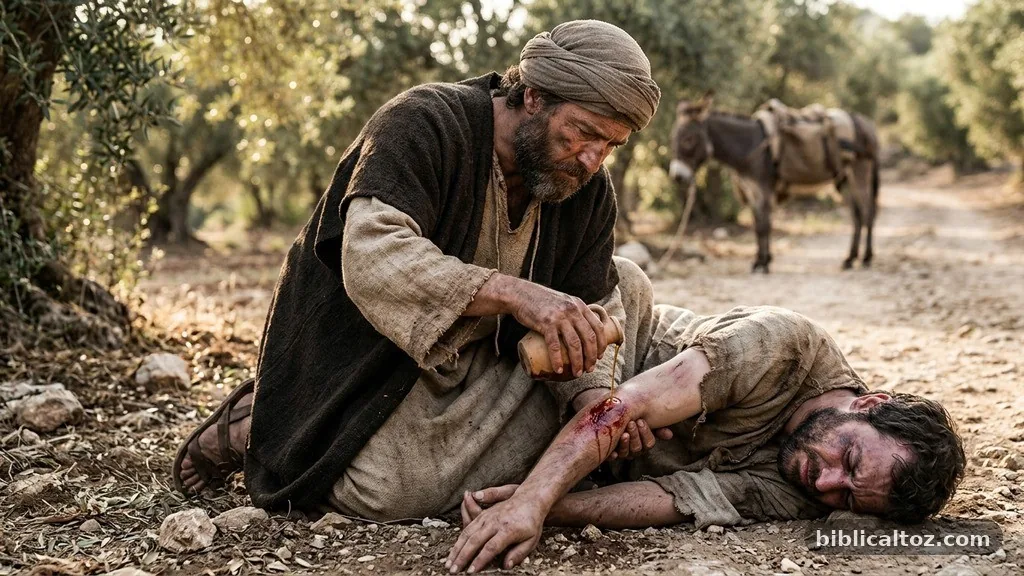
The arrival of the third traveler—a Samaritan—would have stunned the audience. Jews and Samaritans shared a deep-seated historical and religious animosity that had lasted for centuries. By making the hero of the story a Samaritan, Jesus shattered the social expectations of his listeners.
The Samaritan did not just feel pity; he actively intervened. He bandaged the wounds, poured on oil and wine, placed the man on his own animal, and took him to an inn to ensure his recovery.
- He saw the need despite the inherent danger of the road.
- He sacrificed his own time and personal safety to assist a stranger.
- He used his own resources, including oil, wine, and money, to facilitate healing.
- He made a long-term commitment to the victim’s welfare by promising to cover further costs.
Common Misconceptions
A frequent error in interpreting this story is viewing it as a simple lesson on being “nice.” The parable of the Good Samaritan is not merely a moralistic tale about charity; it is a radical dismantling of prejudice. Some believe the priest and Levite were simply “bad” people, but the text suggests they were likely acting according to their rigid interpretation of religious duty.
They prioritized their legalistic purity over the sanctity of human life. The story teaches that true love for God is inseparable from love for our neighbor, even when that neighbor is someone we are conditioned to dislike or avoid.
Practical Application for Today
Living out the lessons of this parable requires an honest assessment of our own biases. We often define our neighbors as those who are like us—members of our own social, political, or religious circles.
The story challenges us to widen that circle to include those who are different or even those we might consider rivals. It asks us to consider who we are ignoring because they are inconvenient or because helping them might cost us our comfort, status, or perceived purity.
Frequently Asked Questions
What is the primary message of the parable of the Good Samaritan?
The main point is that love for one’s neighbor is not limited by ethnicity, social status, or religious differences. It defines a neighbor as anyone who is in need, regardless of their background.
Why did the priest and Levite ignore the man?
While the text does not explicitly state their internal thoughts, it is widely understood that they likely feared becoming ritually unclean, which would have restricted their ability to serve in the temple.
Is this story found in more than one Gospel?
No, this specific account is found only in the Gospel of Luke. It is unique to Luke’s emphasis on Jesus’ ministry to outcasts and those marginalized by society.
Does the parable teach that we should ignore religious laws?
The story does not suggest that God’s law is unimportant. Instead, it corrects a misunderstanding of the law, showing that the weightier matters of mercy and love must take precedence over narrow, self-serving interpretations of religious requirements.
How can I apply this story in my daily life?
Application begins by noticing the people in your sphere of influence who are suffering or overlooked. It involves moving beyond feelings of pity toward tangible action that meets the actual needs of others.
What did the oil and wine represent in the story?
In the first century, these were standard items used for medical care. Oil was used to soften wounds, and wine—which contained alcohol—served as an antiseptic. They represent the practical, physical care the Samaritan provided.
Why would the audience have been shocked by the Samaritan?
Because of the deep historical and religious divide between Jews and Samaritans, the original listeners would have viewed the Samaritan as an enemy. Using him as the hero of the story was a profound challenge to their worldview.
Conclusion
The parable of the Good Samaritan remains a timeless call to radical compassion. It forces us to look past our own prejudices and the barriers we build to protect our comfort. By identifying the Samaritan as the true model of neighborly love, Jesus redefined what it means to follow God.
True faith is not found in avoiding those who are different, but in the active, sacrificial pursuit of mercy. As you reflect on this story, consider who the “half-dead” person on your path might be today. You are invited to move beyond passive observation and take the initiative to offer help, showing the same love that God has shown to you.