Armageddon in the Bible Explained: Meaning and Prophecy
When people hear the word Armageddon, they often think of asteroid impacts, cinematic blockbusters, or the literal end of the world. However, the biblical reality is far more focused on the sovereignty of God and the ultimate victory of Jesus Christ over evil.
By looking at Armageddon in the Bible explained through the lens of original scripture, we can move past popular misconceptions and grasp the profound message of hope found in the book of Revelation. This exploration clarifies the significance of the term, its historical roots, and what it truly signifies for the future of humanity.
What Is Armageddon in the Bible?
The term Armageddon appears only once in the entire Bible, found in Revelation 16:16. It is a transliteration of the Hebrew term Har-Magedon, which translates to the Hill or Mountain of Megiddo.
Rather than describing a chaotic, uncontrolled disaster, the text depicts a specific gathering point where the kings of the whole world are assembled by demonic spirits for battle against the Almighty. It serves as the staging ground for the final stand of the forces of darkness against the kingdom of God.
Where Is Armageddon Mentioned in the Bible?
While the specific name appears exclusively in Revelation 16:16, the concept of a final gathering for divine judgment is woven throughout prophetic literature. Interpreters often connect this event to several other passages that describe the climactic conflict at the end of the age.
- Revelation 16:12–16: The direct mention of the gathering at Armageddon.
- Revelation 19:11–21: The account of Christ returning to defeat the beast and the kings of the earth.
- Zechariah 12:1–14: A prophecy concerning Jerusalem being besieged by nations.
- Joel 3:1–16: A description of the Valley of Jehoshaphat where the Lord judges the nations.
- Revelation 20:7–10: The final rebellion of Gog and Magog after the thousand-year reign.
What Happens at Armageddon?
In Revelation 16, the sixth bowl of God’s wrath is poured out on the great river Euphrates, drying it up to prepare the way for the kings from the East. John describes three unclean spirits that look like frogs, emerging from the mouths of the dragon, the beast, and the false prophet.
These spirits perform signs to gather the rulers of the earth for the battle of the great day of God Almighty. It is a mobilization of human and spiritual rebellion that culminates in a direct confrontation with the divine.
The Meaning of Har-Magedon
Scholars generally agree that the name points toward the ancient city of Megiddo. Located in the Jezreel Valley of Israel, Megiddo was a site of numerous historical battles due to its strategic position on a major trade route.
While some suggest the term is metaphorical, referring to a symbolic mountain of assembly, others argue it highlights the historical pattern of conflict in that region. Regardless of the geography, the focus remains on the spiritual reality of the confrontation rather than a modern military campaign.
Is Armageddon the End of the World?
It is a common error to conflate the gathering at Armageddon with the total destruction of the planet. In the biblical narrative, Armageddon is a specific event of judgment, not the final termination of existence.
Following the defeat of the beast and the false prophet in Revelation 19, the world continues into the millennial reign of Christ. The true end of the current heavens and earth, leading to the creation of the new Jerusalem, occurs only after the events described in Revelation 20.
| Event | Biblical Context | Primary Outcome |
|---|---|---|
| Battle of Armageddon | Revelation 16 & 19 | Victory of Christ over earthly rebellion |
| Millennial Reign | Revelation 20:1-6 | Peaceful rule of Christ on earth |
| Final Judgment | Revelation 20:11-15 | Separation of humanity and creation of new heaven |
Armageddon in Revelation 16 and Revelation 19
These two chapters are inextricably linked by the theme of divine victory. Revelation 16 provides the setup, showing the mobilization of the enemies of God.
Revelation 19 provides the resolution, showing the King of Kings descending from heaven on a white horse to defeat the gathered armies. Interpreters link these passages because they describe the same period of transition where human defiance is met with the irresistible power of the Lord.
Is Armageddon the Same as the Battle of Gog and Magog?
Distinguishing between these events is crucial for an accurate reading of scripture. Ezekiel 38–39 describes a coalition led by Gog from the land of Magog attacking a peaceful Israel.
While some equate this with Armageddon, others point out that the descriptions in Revelation 20:7–10 suggest the battle of Gog and Magog occurs after the thousand-year kingdom of peace. It is best to treat these as distinct manifestations of the ongoing spiritual war between the world and God.
Who Fights at Armageddon?
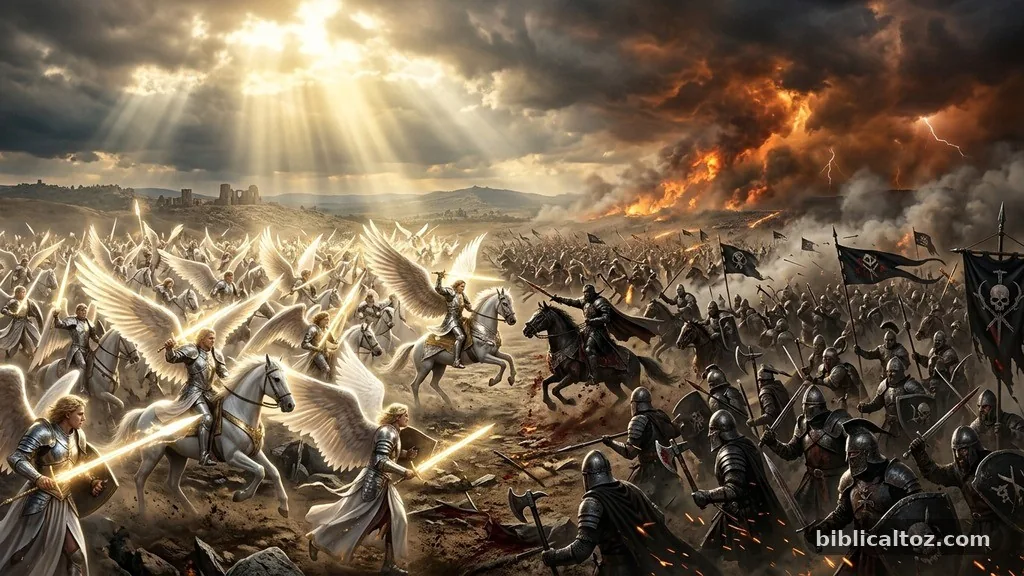
The participants are clearly identified in the text as the demonic powers, the beast, the false prophet, and the gathered kings of the earth. These earthly rulers, deceived by the spirits, align themselves against the Creator.
On the other side stands Jesus Christ, accompanied by the armies of heaven. The contrast is absolute: human pride and demonic influence against the sovereign authority of the Son of God.
What Does Jesus Have to Do With Armageddon?
Jesus is the central figure who resolves the conflict. He does not participate in a conventional war; rather, He speaks the word that brings about judgment.
His presence at the end of the age underscores His role as the rightful King over all creation. Armageddon highlights that all authority in heaven and on earth belongs to Him, and no amount of human or spiritual opposition can withstand His return.
Is Armageddon About Modern Wars?
Many people look at headlines and attempt to map current geopolitical conflicts onto the biblical text. However, the Bible does not provide a roadmap for 21st-century politics.
Trying to identify specific nations or leaders as the players in Revelation often leads to speculation that changes with every news cycle. Instead of looking for current wars, the focus should remain on the timeless message that earthly power is fleeting and only the kingdom of God remains.
Armageddon and the End Times
When considering Armageddon in the Bible explained within the broader eschatological framework, it serves as a signpost of God’s ultimate control. It represents the point where history reaches its climax under the direction of the Creator. This is not about fear or setting dates, but about recognizing the reality of judgment and the promise of a future where God dwells with His people in complete righteousness.
Common Misconceptions About Armageddon
- It is not a random nuclear war, but a divinely ordained event of judgment.
- The word is not used throughout the Bible; it is a singular reference in Revelation.
- It does not imply that God is losing control; it is the moment He asserts His absolute rule.
- Speculating on the date or specific modern nations is not supported by the text.
Bible Verses Related to Armageddon
The significance of this event is best understood by reading the primary sources. Revelation 16:12–16 establishes the context, while Revelation 19:11–21 illustrates the victory.
Zechariah 14:1–5 provides Old Testament imagery of the Lord’s feet standing on the Mount of Olives, which many scholars link to the final events. Reading these passages reveals that the Bible emphasizes the triumph of the King over the chaos of the world.
What Can Christians Learn From Armageddon?
The primary takeaway for the believer is the assurance of God’s sovereignty. Even when the world appears to be spiraling into rebellion, the narrative of scripture confirms that the final victory has already been secured by Jesus.
This truth encourages faithfulness, patience, and hope. Christians are called to live with the awareness that their King will return to set all things right, replacing the brokenness of the current world with His eternal justice.
FAQs
What is Armageddon in the Bible?
It is a location and an event described in Revelation 16:16 where the forces of the world are gathered to oppose God.
What does Armageddon mean?
The term is derived from the Hebrew Har-Magedon, meaning the Hill of Megiddo, a place associated with historical battle.
Where is Armageddon mentioned in the Bible?
It is mentioned explicitly only in Revelation 16:16, though it is linked to broader prophetic themes in Revelation 19, Zechariah 12, and Joel 3.
Is Armageddon a real place?
Megiddo is a real geographical site in Israel, but the biblical description in Revelation uses it as a symbolic site for a global spiritual gathering.
What happens at Armageddon?
Demonic spirits gather the kings of the earth to fight against God, leading to the decisive victory of Jesus Christ.
Is Armageddon the end of the world?
No, it is a specific event of judgment; the final transition to the new heaven and earth occurs later in the book of Revelation.
Is Armageddon the same as Gog and Magog?
Most scholars distinguish between them, as the battle of Gog and Magog is described in a different context in Revelation 20.
Does the Bible say when Armageddon will happen?
The Bible does not provide a timeline or date, emphasizing that the timing is known only to God.
Is Armageddon happening now?
While the world experiences conflict, the specific gathering described in Revelation is a future event related to the return of Christ.
What does Jesus say about the end times?
Jesus warned His followers to stay alert and faithful, emphasizing that His return will be unmistakable and that His kingdom will prevail.
Conclusion
Understanding Armageddon in the Bible explained through the lens of scripture allows us to view the future with confidence rather than anxiety. The narrative is not one of senseless destruction, but of the final restoration of God’s authority over a world that has long rebelled against Him. As we see the pieces of the biblical prophecy align with the promise of Christ’s return, we are encouraged to remain steadfast in our faith.
We invite you to continue your journey through the Word of God at BiblicalToZ, where we provide resources to help you deepen your understanding of these vital truths. May you find peace in the knowledge that your King is coming and that His victory is certain.