The Battle of Jericho: Story, Meaning & Lessons of Faith
The account of the battle Jericho represents one of the most striking moments in the Old Testament. As the Israelites prepared to enter the Promised Land, they faced a formidable city with thick walls that seemed impossible to conquer by conventional military means. This event serves as a profound example of how God’s power works through human obedience and simple trust.
By examining the specific commands given to Joshua and the steady march of the people, you will gain a deeper perspective on how faith in divine instruction often leads to victory where human logic sees only obstacles. Whether you are seeking historical context or spiritual encouragement, this narrative offers timeless insights into walking with the Lord.
What Was the Battle of Jericho?
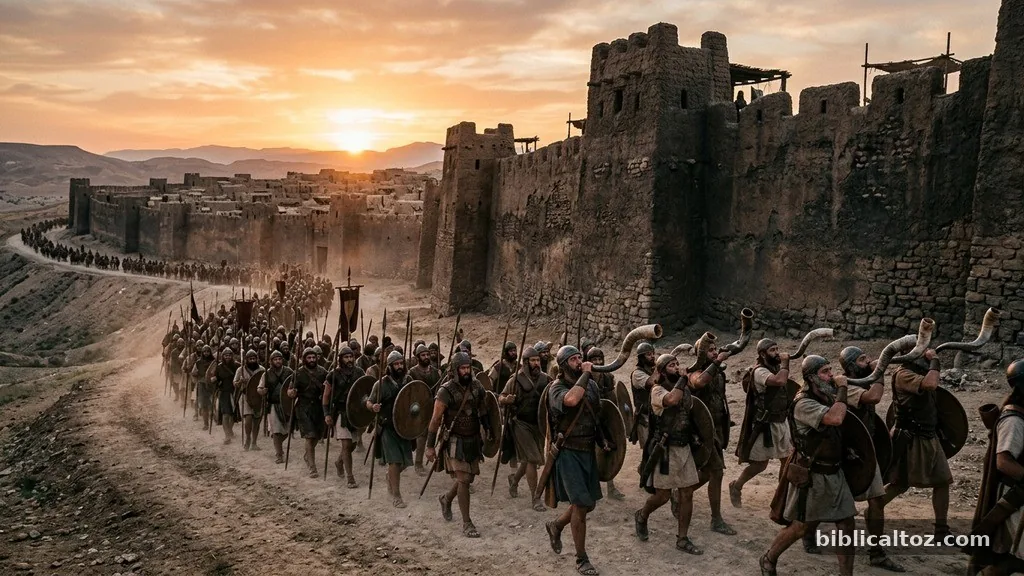
Jericho was a heavily fortified city located in the Jordan Valley. It served as a gateway to the land of Canaan, making it a critical strategic point for the Israelites. Because of its thick, high walls, the city was considered nearly impenetrable to ancient armies. For the Israelites, who had spent decades wandering in the wilderness, the city stood as the first major physical barrier between them and the land promised to their ancestors.
The Background of the Battle
The Israelites had just crossed the Jordan River on dry ground, a miracle that signaled the start of their conquest. Joshua had taken over leadership after the death of Moses, and the people were finally positioned to claim their inheritance. Before the battle Jericho began, the nation was in a state of spiritual preparation, renewing their covenant with God through the rite of circumcision and the celebration of the Passover.
Joshua and the Commander of the Lord’s Army
Before the march began, Joshua encountered a man standing with a drawn sword near the city. When Joshua asked if he was for them or their enemies, the man identified himself as the commander of the army of the Lord. This encounter humbled Joshua, reminding him that the upcoming victory did not depend on his own military prowess. He was merely an instrument in the hand of a much higher power.
God’s Instructions for Jericho
The strategy for the battle Jericho was unconventional and required immense discipline. God provided specific, detailed instructions that prioritized obedience over traditional warfare tactics. The plan centered on the presence of the Lord, symbolized by the Ark of the Covenant, rather than swords or battering rams.
- The priests were to carry the Ark of the Covenant.
- Seven priests were to walk ahead of the Ark, each carrying a ram’s horn.
- The army was to march around the city once per day for six days.
- On the seventh day, they were to march around the city seven times.
- The priests were to blow the horns, and the people were to shout at the right moment.
The Seven Days Around Jericho
For six days, the Israelites followed this plan in silence, save for the sound of the trumpets. This daily routine tested their patience and their willingness to look foolish to their enemies. While the people of Jericho watched from their high walls, the Israelites simply walked and returned to camp. It was a test of endurance, requiring the people to trust that God’s plan would succeed despite the lack of immediate results.
The Fall of Jericho
On the seventh day, the pressure reached its peak. After circling the city seven times, the priests sounded a long, sustained blast on the horns. Joshua commanded the people to shout, and the Bible records that the walls came down flat. This allowed the Israelites to charge straight into the city and take control, proving that the victory was a direct result of divine intervention rather than human strength.
| Day | Action Taken | Military Logic |
|---|---|---|
| Days 1-6 | One march per day | Ineffective |
| Day 7 | Seven marches + shout | Ineffective |
| The Result | Walls collapsed | Supernatural |
Rahab and Her Family
Rahab, a woman who lived in the city, had previously hidden two Israelite spies. Because of her act of faith, she secured a promise that her family would be protected when the city fell. When the attack occurred, the spies honored their word, and Rahab and her household were brought to safety. This highlights that God’s mercy extended to those who recognized His authority, regardless of their background.
Why Did God Command the Destruction of Jericho?
The destruction of the city is often difficult for modern readers to process. Biblically, the conquest was part of a divine judgment against the inhabitants of Canaan, whose practices were described as deeply wicked and contrary to the covenant. The total destruction of the city’s resources also served to emphasize that the victory belonged solely to God, preventing the Israelites from keeping the spoils for themselves.
What Does Jericho Teach About Faith and Obedience?
The story of the battle Jericho is a masterclass in faith. It teaches that God often asks for obedience in ways that do not make sense to the human mind. The Israelites had to refrain from fighting in their own way and instead rely entirely on the promise of the Lord. It serves as a reminder that patience, when combined with active obedience, is a powerful tool for overcoming the obstacles in your own life.
Key Bible Verses About Jericho
- Joshua 6:2: And the Lord said unto Joshua, See, I have given into thine hand Jericho, and the king thereof, and the mighty men of valour.
- Joshua 6:16: And it came to pass at the seventh time, when the priests blew with the trumpets, Joshua said unto the people, Shout; for the Lord hath given you the city.
- Hebrews 11:30: By faith the walls of Jericho fell down, after they were compassed about seven days.
Common Questions About the Battle of Jericho
Did the walls actually fall?
The Bible presents the collapse of the walls as a historical event driven by God’s power. It describes the walls falling down flat immediately after the people shouted.
Why did they march in silence?
The instructions required the people to refrain from talking during the first six days. This silence likely served to keep the focus on the priests and the Ark, preventing them from doubting or questioning the process.
Was the battle of Jericho a real historical event?
For believers, the account is recorded as a factual event in the book of Joshua. It is viewed as a foundational moment in Israel’s history and is referenced throughout the rest of the Bible.
What can I learn from Rahab?
Rahab demonstrates that faith is not limited by one’s past or status. Her willingness to act on her belief in the God of Israel resulted in the salvation of her entire family.
Conclusion
The battle Jericho remains one of the most powerful narratives in Scripture because it highlights the intersection of human action and divine power. It reminds us that when we choose to follow the Lord’s instructions—even when they seem unconventional—we position ourselves to witness His work in our lives. The walls that seem impossible to move often crumble when we trade our own logic for consistent, faithful obedience. As you reflect on this story, consider what areas of your life require a new level of trust in God’s timing. You are invited to move forward with the same confidence as Joshua, knowing that the One who led the Israelites into their promise is the same One who guides your path today.